Comments on news in Canada and the world, Christian ethics, the Catholic Church, Church history,travel and English grammar.
Friday, May 30, 2014
Lead, Kindly Light: the Story of John Henry Newman
John Henry Newman was born in London February 21, 1801; the eldest of six children. His parents were Anglican and as a child Newman studied at Ealing, a private boarding school where he exhibited an unusual interest in theology, despite his young age.
His later studies were at Oxford and at the age of twenty-one he became a professor at Oxford and a minister in the Church of England (Anglican). His first book was The Arians of the Fourth Century (1833) and he had a great love for the Fathers of the Church. He also wrote poetry and one of his poems was set to music, the well-known hymn, Lead Kindly Light.
Newman and the Oxford Movement
Newman is the best-known member of the Oxford Movement – a group of men whose aim was to invigorate the Anglican Church through spiritual renewal and renunciation of liberalism in the 1830s. They also, at first, condemned what they viewed as the corruptions of the Roman Church. This was Newman's undoing, for in the end his studies of the Church Fathers ultimately led him to that very Church. He discovered that as far back as the Church Fathers, the doctrines of the Church were the same as those that the Roman Catholic Church taught. He said, "When one reads history, he ceases to be a Protestant."
Newman's Resignation from Oxford
In 1841, Newman published Tract 90 in which he claimed that the Thirty-nine Articles of the Church of England (written in 1563 during the reign of Elizabeth I) were essentially Catholic Doctrine as it had been both in the early church and at the Council of Trent.
A great controversy arose and he was eventually forced to resign both his teaching post at Oxford and his position at the University church of St. Mary the Virgin (Church of England).
Reception into the Catholic Church
In October, 1845, after many years of study and intellectual struggle he was received into the Catholic Church. Two years later he was ordained to the Catholic priesthood in Rome and then joined the Oratorians in Birmingham, England. At the age of 78, he was made a Cardinal by Pope Leo XIII. He died in 1890.
John Henry Newman's Writings
Some of Newman's well-known writings include:
• Essay on the Development of Christian Doctrine
• The Idea of the University
• Letter to Pusey
• Apologia pro Vita Sua (his autobiography)
In the story of his conversion, told in Apologia Pro Vita Sua, he says, "From the time that I became a Catholic...I have been in perfect peace and contentment, I never have had one doubt...and my happiness on that score remains to this day without interruption."
It is said Newman's English prose is the most beautifully written of all.
Sainthood
In October, 2019 Pope Francis canonized John Cardinal Newman as a Saint of the Church.
Sources
Connor, Fr. Charles P. Classic Catholic Converts. San Francisco: Ignatius Press. 2001
Ker, Ian. John Henry Newman: A Biography. Oxford: Oxford University Press. 1988.
John Henry Newman. Apologia pro Vita Sua. New York:WW. Norton and Company, 1968. p. 184.
Friday, May 16, 2014
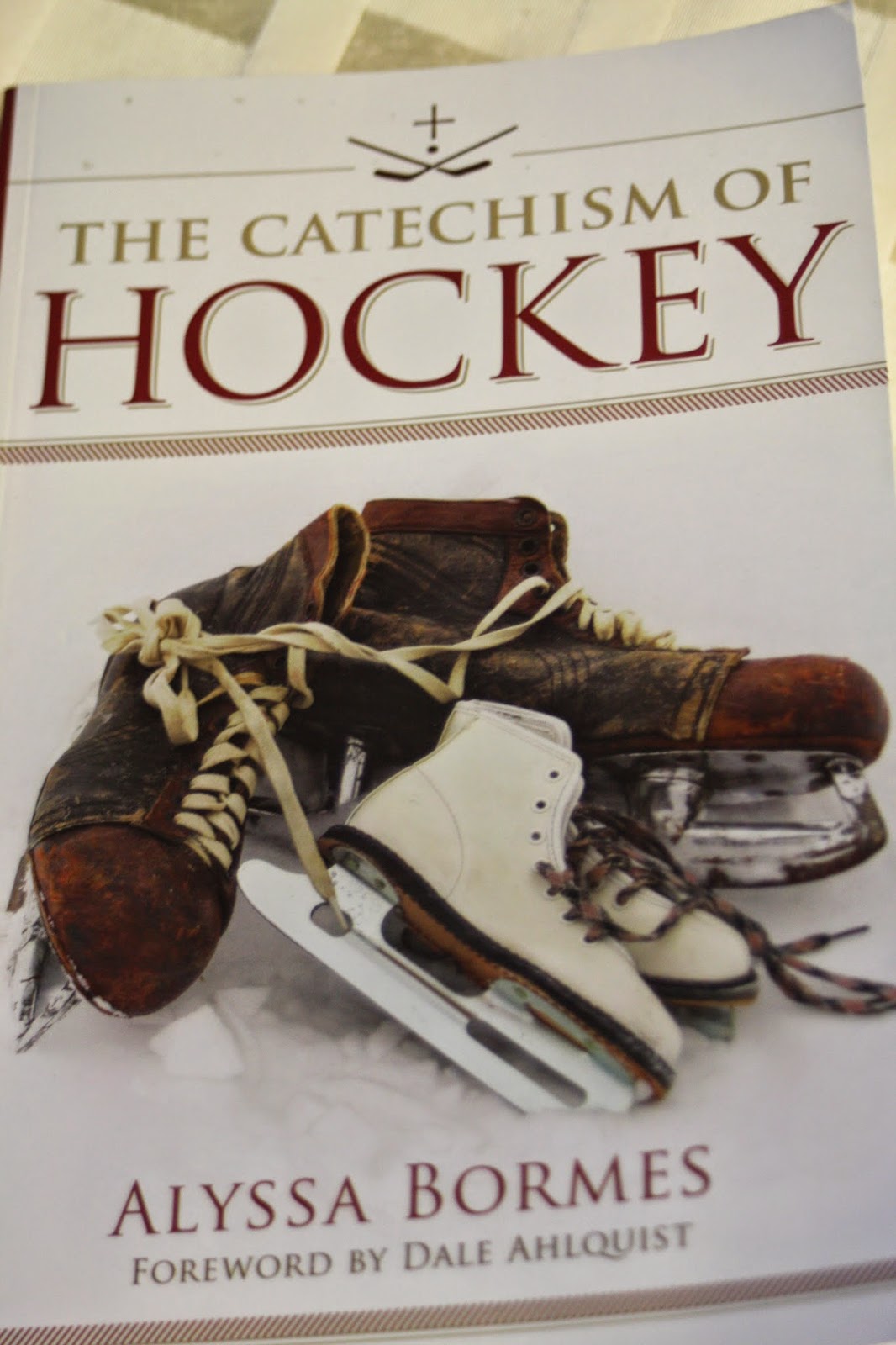
Book Review: The Catechism of Hockey by Alyssa Bormes
The Catechism of Hockey. Alyssa Bormes. The American Chesterton Society. 2013 by Lorraine Shelstad
Many catechists have asked themselves the questions; I know I did. Why do parents drive miles to take their children to a hockey game at 5:30 am on a Saturday but complain bitterly that they are expected to attend Mass on Sunday? Why do parents spend hundreds of dollars on hockey equipment but don’t like to spend anything on their child’s religious education? And why do children happily obey the rules and the decisions of the hockey ref but complain about the ‘rules’ of the Church? Well somebody who knows hockey much better than I do, wrote a book about it. Her favourite statement? “Ah, Catholicism is so much like hockey!” And you will be surprised at the comparisons she finds.
If you like hockey, if you play hockey or are a hockey Mom or Dad this book is for you. If your child plays any other game - like soccer, baseball or basketball - you should still read this book. It is especially written with passing the faith of Catholicism on to our children in mind and makes pretty good sense. We want our children to succeed in hockey and we want our children to succeed in life. So how do we accomplish these expectations?
Some things Bormes asks us to think about:
- If you play hockey you can't pick out the rules you like and will follow and those you won't. You have to take to the complete package. If you change the rules to something you like better, it ain't hockey!
- If you think hockey is fun but the Mass isn't, maybe it's because you understand hockey but not Mass. I don't understand hockey very well and I guess that is why I don't watch it. On the other hand, I love going to Mass.
- Can we get as excited about Catholicism as we do about hockey? I think we can.
- Maybe sometimes we need to say, if you don't like the rules of the game, play a different game.
The author, Alyssa Bormes, who is from Minnesota, claims that Minnesota is the hockey state. She may be right. My only complaint about the book is that although she mentions Bobby Orr, Wayne Gretzky, Maurice Richard and the Stanley Cup she never mentions that all of these are Canadian! I know Canada has only 35 billion people and they may not buy as many books as Americans but would it hurt to at least say that what she calls ‘the ultimate prize’ of hockey, the Stanley Cup, originated in Canada and was a gift from Lord Stanley, the Governor-General of Canada in 1893.
I know a Canadian team hasn’t won it lately (since 1993) but many of the players on American teams learned to skate on the quintessential outdoor rinks of their home country, Canada.
Don’t let that stop you from buying the book which has many words of wisdom about passing our Catholic faith on to our children.
Many catechists have asked themselves the questions; I know I did. Why do parents drive miles to take their children to a hockey game at 5:30 am on a Saturday but complain bitterly that they are expected to attend Mass on Sunday? Why do parents spend hundreds of dollars on hockey equipment but don’t like to spend anything on their child’s religious education? And why do children happily obey the rules and the decisions of the hockey ref but complain about the ‘rules’ of the Church? Well somebody who knows hockey much better than I do, wrote a book about it. Her favourite statement? “Ah, Catholicism is so much like hockey!” And you will be surprised at the comparisons she finds.
If you like hockey, if you play hockey or are a hockey Mom or Dad this book is for you. If your child plays any other game - like soccer, baseball or basketball - you should still read this book. It is especially written with passing the faith of Catholicism on to our children in mind and makes pretty good sense. We want our children to succeed in hockey and we want our children to succeed in life. So how do we accomplish these expectations?
Some things Bormes asks us to think about:
- If you play hockey you can't pick out the rules you like and will follow and those you won't. You have to take to the complete package. If you change the rules to something you like better, it ain't hockey!
- If you think hockey is fun but the Mass isn't, maybe it's because you understand hockey but not Mass. I don't understand hockey very well and I guess that is why I don't watch it. On the other hand, I love going to Mass.
- Can we get as excited about Catholicism as we do about hockey? I think we can.
- Maybe sometimes we need to say, if you don't like the rules of the game, play a different game.
The author, Alyssa Bormes, who is from Minnesota, claims that Minnesota is the hockey state. She may be right. My only complaint about the book is that although she mentions Bobby Orr, Wayne Gretzky, Maurice Richard and the Stanley Cup she never mentions that all of these are Canadian! I know Canada has only 35 billion people and they may not buy as many books as Americans but would it hurt to at least say that what she calls ‘the ultimate prize’ of hockey, the Stanley Cup, originated in Canada and was a gift from Lord Stanley, the Governor-General of Canada in 1893.
I know a Canadian team hasn’t won it lately (since 1993) but many of the players on American teams learned to skate on the quintessential outdoor rinks of their home country, Canada.
Don’t let that stop you from buying the book which has many words of wisdom about passing our Catholic faith on to our children.
Monday, April 21, 2014
Is the Resurrection True?
The Resurrection of Jesus is considered the cornerstone of belief of all mainstream orthodox Christians. St. Paul writes, “If Christ has not been raised, then empty is our preaching; empty, too, our faith.” (I Corinthians 15:14). In other words without the bodily resurrection of Jesus from the dead, Christianity has no valid message. The resurrection is the ‘good news'; Jesus has been victorious over sin and death. The Church defines resurrection as the rising from the dead and resumption of life and has always proclaimed its belief that three days after his death Jesus rose from the dead.
Let us examine, then, the events surrounding the resurrection, the arguments against it and the counter-arguments.
Jesus’ Death
The four Gospel writers (Matthew, Mark, Luke and John) all give accounts of the death of Jesus by crucifixion, the discovery of his empty tomb and the appearances of a living Jesus after his death. The Catholic Church and other orthodox Christians believe in the historical reliability of this Scriptural account. Although the four accounts relate some different details they are basically the same and do not contradict each other.
While in the Garden of Gethsemane, Jesus was arrested and then brought before the Sanhedrin, the council of Jewish leaders. Although there were other charges against him, the main charge against Jesus was that of blasphemy. He had claimed to be the Messiah and the Son of God (Luke 22:70,71); a very serious matter in Jewish law. The Jewish leaders brought him before the Roman authorities as they had no authority to execute criminals in the Roman Empire. At first the Romans said it was not their problem. Pilate said he did not find that Jesus had done anything illegal according to Roman Law but in the end, at the insistence of the gathered crowd, he agreed to crucify Jesus, the Roman method of capital punishment at that time.
Reports of the Resurrection
After he was taken down from the cross, Jesus was buried in the tomb of Joseph of Arimathea, a secret follower of Jesus, and the tomb was sealed by a huge stone at the entrance. The chief priests and Pharisees asked Pilate to place guards at the tomb because they were afraid his disciples would come to the grave, steal the body and then claim that Jesus had risen from the dead. Jesus had implied that he would rise from the dead saying, ‘Destroy this temple and in three days I will raise it up.’ (see John 2:19-22). He was referring to his body and not the literal temple. The disciples, however, did not understand Jesus’ meaning until after his resurrection.
In the morning, several guards hurried to the chief priests to report that during the night there had been an earthquake and an angel had rolled the stone away . The guards were struck with fear. The chief priests decided that they would pay the guards to say that the disciples had come and stolen the body while they were sleeping and promised them they would not be punished for the disappearance of the body. The guards must have been well-paid for they agreed to tell that version of the story even though it made them look very incompetent!
The disciples did not go to the tomb on Saturday which was the Jewish Sabbath and it was forbidden to travel. On the first day of the week (Sunday) some women followers of Jesus went with spices to embalm the body. When they arrived they found that the stone had been rolled away and the tomb was empty. A man in white clothing, actually an angel, asked them why they sought the living among the dead. He told them that Jesus was not there but had risen from the dead. The women hurried back to tell the disciples the news but they thought it was an idle tale - as usual the men thought that the women were imagining something! But Peter and John wanted to check the story out and ran to the tomb confirming that Jesus’ body was no longer there.
Jesus Appears to His Disciples
After this Jesus appeared to many of his disciples: Mary Magdalene, the twelve Apostles hiding in a locked room in Jerusalem, two believers on the road to Emmaus, two groups of ‘pious’ women and his disciples again on the shore of the Sea of Tiberius. St. Paul reports that Jesus also appeared to Cephas (Peter) and 500 believers, many of whom were still alive at the time St. Paul wrote the letter to the Church at Corinth (see I Corinthians 15:5-7).
The Church has always believed the accounts of the Gospel writers but there are several alternate theories of what could have happened.
The Stolen Body Theory
This, of course, was the first theory that was circulated by the Jewish authorities of the time: the disciples of Jesus came and stole the body. According to the Gospel accounts the guards were bribed to lie and say that this is what happened. But, if the disciples had come to steal the body, why didn’t the guards prevent the disciples from rolling away the stone? After all, that is the task they had been hired to do, they were armed and probably outnumbered any disciples who would have come. The guards claimed that they had fallen asleep but surely guards would have taken turns sleeping in order to prevent a theft. Would they have slept so soundly as to not have heard a group of men rolling away the stone? If they had fallen asleep and failed to prevent the theft of the body, they very likely would have been punished. In the end, the money, and the promise that they would not get into trouble for their incompetence, was enough compensation for them to tell the lie. If the disciples did indeed steal the body what did they do with it after? Anyone wanting to discredit them would just have to prove that the body of Jesus had been buried elsewhere.
The apostles spent the rest of their lives preaching that Jesus had risen from the dead. Would they do this for what they knew was a lie? What did they gain from it? Wouldn’t it have been better to keep a low profile and go back to what they had been doing before they met Jesus? Instead many of them died for their faith. Would not at least one of them chickened out and confessed rather than lose his life for something that was not true?
The Swoon Theory
This theory claims that Jesus did not die but was just unconscious when he was put in the tomb. When he revived, he came out of the tomb and was seen alive by his disciples.
Since Jesus had been whipped before his crucifixion and then spent agonizing hours hanging on a cross meant to kill him, it is unlikely that he survived. The Romans were very good at making certain a criminal did not live through crucifixion. Before taking Jesus’ body down from the cross a soldier thrust a sword into Jesus’ side and blood and water poured out. His body is placed in a tomb where there was little air and no food or water for three days. If Jesus was not dead and merely revived was he able to move the heavy stone at the entrance or did someone else move it? If this theory were true, Jesus would need a lot of care after leaving the tomb. If he did recover would he not eventually be seen and recognized by others? The Gospel accounts say that after his resurrection, Jesus only appeared to those who believed he was the Messiah. And if this theory is true, when did he die? One day there would be a dead Jesus and if someone discovered the body, the game would be up!
The Hallucination Theory
This theory proposes that the followers of Jesus so much wanted to believe that he was not dead and that he had risen, that they had visions of him after his death and burial. In their stressful mental state and knowing that Jesus said ‘he would return’ they were susceptible to having hallucinations. It is true that people have had this type of vision after the death of a family member or close friend, however, it is unusual for many people to have the same vision. As well, normally visions do not last as long as the appearances of Jesus did. And why did the visions end abruptly? Luke reports that Jesus ascended to heaven and after that no one saw him again.
The disciples had not really understood what Jesus had said about being ‘raised up in three days’ and only understood his meaning after they had seen the resurrected Jesus. The two men on the road to Emmaus had to have it explained to them by Jesus, whom they did not recognize at first.
The story of the disciple Thomas is interesting in the light of this theory. John writes that Thomas was not in the locked room when Jesus first appeared to the Apostles. When hearing what had happened during his absence, Thomas says he will not believe unless he sees the wounds with his own eyes. Jesus later appears to Thomas, shows him his wounds and even allows him to touch them. If the psychological vision theory were true it is unlikely that Thomas would have this kind of vision. And if the resurrection were not true for any other reason, it is unlikely that any gospel writer would include this story of a ‘doubting’ disciple who eventually believed that Jesus had risen from the dead.
The Modernist or Myth Theory
The most recent theory is one which says that Jesus’ body remained in the tomb and decomposed and the resurrection spoken of in Scripture is not a literal but a spiritual or supernatural ‘resurrection’. It is meant to portray Jesus’ spiritual victory over death or his immortality in a spiritual sense. Some would also claim that the resurrection crept into the Gospel accounts from ancient religions. However, the Greeks believed in the resurrection of the soul but not the body. Other religions (Hinduism and Buddhism, for example) believe in re-incarnation - the soul living on in another body but not a bodily resurrection. There was a tradition of resurrection of the body in Judaism amongst the Pharisees whereas the Sadducees did not believe in resurrection. St. Paul, a Pharisee, used this disagreement to his advantage when on trial, "For the Sadducees claim that there is neither resurrection, nor angels nor spirits, while the Pharisees acknowledge all these things." (see Acts 23:8)
The Modernist Theory gives rise to the same problem as those in the other theories. Why didn’t someone produce the body of Jesus? There would have been many who wanted to discredit the claim of the disciples. Why has the so-called myth persisted for 2000 years? Why has it been literally believed world-wide by people of many different cultures, education and backgrounds?
Conclusion
As mentioned, the simplest way to disprove the resurrection would have been to produce the body of Jesus. No one was able to do this, in spite of the fact that many would have wanted to show that the disciples had lied. Those who had bribed the guards would have loved to have found the body of Jesus in order to prove that they were right. For the remainder of their lives, the apostles put themselves in danger by preaching the death and bodily resurrection of Jesus. They were stoned to death (Stephen), put in jail (Peter, Paul), and crucified (Peter)or beheaded (Paul). Many later believers were also killed by the Romans. In fact, there are still people being killed worldwide for their faith in a Jesus they believe rose from the dead.
Christians believe that Jesus rose from the dead and that they, too, will be raised to everlasting life. "But Jesus said to her (Martha), "I am the resurrection and the life; whoever believes in me, even if he dies, will live." John 11:25
Sources
Berkhof, L. Systematic Theology. Grand Rapids, Michigan: Wm. B. Eerdmans. 1962.
Hahn, Dr. Scott. The Bodily Resurrection of Christ. CD Sycamore, Il: Lighthouse Catholic Media, NFP. 2011
Catholic Encyclopedia- New Advent website. Accessed July 8, 2012.
New American Bible. New York: Catholic Book Publishing Co. 1970.
Thursday, March 20, 2014
Jacques Maritain: Philosopher of the 20th Century
Jacques Maritain helped to draft the United Nations Declaration of Human Rights in 1948 and re-introduced Thomism for the modern world.
Maritain was one of the great thinkers of the twentieth century. He not only helped to draft the United Nations Declaration of Human Rights in 1948 but influenced the Canadian Charter of Rights and Freedoms and the preamble to the Constitution of the Fourth French Republic (1946). But perhaps his greatest contribution was to adapt the thought of St. Thomas Aquinas to the modern world.
Early Life, Education and Search for Truth
Jacques Maritain was born in Paris in November, 1882. His father was a lawyer who was neither hostile to religion nor attracted to it. His mother, Genevieve Favré, was brought up to believe that the supernatural had no right in the affairs of state. When Jacques was young his parents separated. He continued to have a great thirst for knowledge and read constantly.
While studying at the Sorbonne, Jacques met Raissa Oumansoff, the daughter of Russian Jewish immigrants. They were both involved in protests against the treatment of Russian socialist students at the Sorbonne. As their friendship grew they found joy in their companionship but were plagued about the absurdity of existence and both had many religious doubts. They married in 1906 and shortly after made a pact to commit suicide if their questions about life were not answered within a year. Then they happened to read a book by Leon Bloy, an intellectual who was a Christian and a Catholic. Jacques and Raissa made an appointment to meet him and eventually they became lifelong friends. The Maritains began to study Catholicism and after much soul-searching they were baptized and received into the Catholic Church in June, 1906. One thing that had bothered them was that some people who called themselves Christian did not live up to the teaching of Jesus. Even with these doubts, after their baptism they both experienced peace and joy that they had never known before.
Not surprisingly, Raissa’s parents viewed her conversion as a betrayal to her heritage and Jacques’ mother was immensely disappointed that he had not followed in his socialist grandfather’s footsteps. The Maritains moved to Heidelberg, Germany where Jacques continued his studies. Although Raissa was unwell she continued to read and study at home.
Introduction to Thomas Aquinas
When they moved back to Paris, a Dominican priest and friend, Father Humbert, recommended St. Thomas Aquinas’ Summa theologia to Raissa. She was enthralled by it and passed on her enthusiasm to her husband. They both found answers in Thomism’s rational logic and Jacques said that it was ‘common sense amongst the confusion that reigned in the world’. Both Jacques and Raissa strongly believed, as St. Thomas did, that faith and reason were compatible and not enemies. Scholars have said that Maritain’s most significant contribution in philosophy was to adapt Thomism to modern thought.
Post-War Life and Work
When the Nazis invaded France, Jacques was lecturing at the Pontifical Institute of Medieval Studies in Toronto. He and Raissa decided not to return to Europe, especially since his wife’s Jewish background was well-known. After the war, Charles de Gaulle asked him to be France’s ambassador to the Holy See (1945-1948). He later taught at Princeton University in New Jersey (1941-1942) and Columbia (1942 -1944) and lectured at The University of Notre Dame and The University of Chicago.
Maritain wrote against anti-Semitism, describing it as a sin against God’s people and, because of these writings, had an influence on those who wrote Vatican II’s statement on the Jews.
Raissa died in 1960 and Jacques returned to France. He lived with a religious community, the Little Brothers of Jesus at Toulouse, until his death in 1973 at the age of ninety-one.
Some of Jacques Maritain’s Books
France, My Country through the Disaster. 1941
Art and Poetry. 1943
Education at the Crossroads. 1943
Christianity and Democracy. 1943
Reflections on America. 1958
Man and the State. 1952
Le paysan de la Garonne. 1967
Sources
Connor, Fr. Charles P. Classic Catholic Converts. San Francisco: Ignatius Press. 2001.
Myers, Rawley. Faith Experiences of Catholic Converts. Huntingdon, IN: Our Sunday
Visitor, Inc. 1992.
Stanford Encyclopedia of Philosophy website accessed May 20, 2011.
Maritain was one of the great thinkers of the twentieth century. He not only helped to draft the United Nations Declaration of Human Rights in 1948 but influenced the Canadian Charter of Rights and Freedoms and the preamble to the Constitution of the Fourth French Republic (1946). But perhaps his greatest contribution was to adapt the thought of St. Thomas Aquinas to the modern world.
Early Life, Education and Search for Truth
Jacques Maritain was born in Paris in November, 1882. His father was a lawyer who was neither hostile to religion nor attracted to it. His mother, Genevieve Favré, was brought up to believe that the supernatural had no right in the affairs of state. When Jacques was young his parents separated. He continued to have a great thirst for knowledge and read constantly.
While studying at the Sorbonne, Jacques met Raissa Oumansoff, the daughter of Russian Jewish immigrants. They were both involved in protests against the treatment of Russian socialist students at the Sorbonne. As their friendship grew they found joy in their companionship but were plagued about the absurdity of existence and both had many religious doubts. They married in 1906 and shortly after made a pact to commit suicide if their questions about life were not answered within a year. Then they happened to read a book by Leon Bloy, an intellectual who was a Christian and a Catholic. Jacques and Raissa made an appointment to meet him and eventually they became lifelong friends. The Maritains began to study Catholicism and after much soul-searching they were baptized and received into the Catholic Church in June, 1906. One thing that had bothered them was that some people who called themselves Christian did not live up to the teaching of Jesus. Even with these doubts, after their baptism they both experienced peace and joy that they had never known before.
Not surprisingly, Raissa’s parents viewed her conversion as a betrayal to her heritage and Jacques’ mother was immensely disappointed that he had not followed in his socialist grandfather’s footsteps. The Maritains moved to Heidelberg, Germany where Jacques continued his studies. Although Raissa was unwell she continued to read and study at home.
Introduction to Thomas Aquinas
When they moved back to Paris, a Dominican priest and friend, Father Humbert, recommended St. Thomas Aquinas’ Summa theologia to Raissa. She was enthralled by it and passed on her enthusiasm to her husband. They both found answers in Thomism’s rational logic and Jacques said that it was ‘common sense amongst the confusion that reigned in the world’. Both Jacques and Raissa strongly believed, as St. Thomas did, that faith and reason were compatible and not enemies. Scholars have said that Maritain’s most significant contribution in philosophy was to adapt Thomism to modern thought.
Post-War Life and Work
When the Nazis invaded France, Jacques was lecturing at the Pontifical Institute of Medieval Studies in Toronto. He and Raissa decided not to return to Europe, especially since his wife’s Jewish background was well-known. After the war, Charles de Gaulle asked him to be France’s ambassador to the Holy See (1945-1948). He later taught at Princeton University in New Jersey (1941-1942) and Columbia (1942 -1944) and lectured at The University of Notre Dame and The University of Chicago.
Maritain wrote against anti-Semitism, describing it as a sin against God’s people and, because of these writings, had an influence on those who wrote Vatican II’s statement on the Jews.
Raissa died in 1960 and Jacques returned to France. He lived with a religious community, the Little Brothers of Jesus at Toulouse, until his death in 1973 at the age of ninety-one.
Some of Jacques Maritain’s Books
France, My Country through the Disaster. 1941
Art and Poetry. 1943
Education at the Crossroads. 1943
Christianity and Democracy. 1943
Reflections on America. 1958
Man and the State. 1952
Le paysan de la Garonne. 1967
Sources
Connor, Fr. Charles P. Classic Catholic Converts. San Francisco: Ignatius Press. 2001.
Myers, Rawley. Faith Experiences of Catholic Converts. Huntingdon, IN: Our Sunday
Visitor, Inc. 1992.
Stanford Encyclopedia of Philosophy website accessed May 20, 2011.
Labels:
Catholic Church,
conversion,
jewish,
Maritain,
philosophy,
St. Thomas Aquinas,
Thomism,
United Nations
Tuesday, February 11, 2014
The Facts About the Sexual Abuse Crisis in the Catholic Church Part I
As the sexual abuse scandal in the clergy of the Catholic Church came to light in the late 1980s, both Catholics and non-Catholics were shocked and horrified. How could men who had taken vows of obedience and chastity take advantage of young people who trusted them? How could anyone do such terrible things to innocent children and young teens, things that would haunt them forever and change their lives? The sex abuse scandals have done more damage to the children, their families, the priesthood and the Church than one can ever imagine. Those who abused children or tried to cover it up will have much to answer to God.
Many articles and books have been written about the sexual abuse scandal in the Catholic Church. Some articles are balanced and informed and yet there are blatantly false and misleading reports which continue to circulate as well. The UN report (February, 2014) damning the Church for inaction and ignoring the positive action that has been taken by the Church seems to have been written with extreme hatred of the Catholic Church. This blog-article will examine some of the official reports and studies that have been done and their findings. Of course, it is impossible to look at all studies but hopefully a wide range of ideas can be presented here and the truth can be investigated fairly.
Was the Abuse Pedophilia?
Pedophilia is defined as ‘a sustained interest in prepubescent children (before the age of puberty)’ but not all pedophiles act on their fantasies and not all child molesters are pedophiles. (The Encyclopedia of Mind Disorders). Most priests who were found guilty of sexual abuse were attracted to post-pubescent boys between the ages of 13 and 17 and so are technically not pedophiles. It is a moot point whether a boy who has been abused is seven or fourteen - he is still a minor and the abuser is still a criminal. (Friscolanti).
The majority of priests who abused children were actually self-declared homosexuals and were in a homosexual relationship at the time. This does not mean that all homosexuals are abusers of minors and there has been no evidence that this is the case. Both gay and straight people are disgusted at the thought of child abuse. (Coren, p. 18,19). One study says that in 3,000 cases of abuse reported to the Congregation for the Doctrine of the Faith 60% involved homosexual activity. (Lifesite news) Coren suggests that priests guilty of abuse “... either used the priesthood as a cover for their sexual desires or gave in to temptations at some point during or after their time at the seminary.” (Coren, p. 19)
Friscolanti writes in a MacLean’s Magazine article that between 30-50% of priests are homosexuals, depending on the study. At that time,the Catholic Church did not stipulate that homosexuals could not be priests. They took a vow of celibacy just as heterosexual priests did and so their sexual orientation was not relevant. In recent years, however, because of the scandals, there has been a change using more caution when accepting known homosexuals for candidates as priests. Because of this change the Church is now criticized and called ‘homophobic’ so it seems no matter what the Church does it cannot win!
Celibacy (i.e. priests must not marry) is often blamed for the sex abuse by Catholic clergy. Is this the source of the problem and should the Church change its ‘ruling’ on married priests? There are some who think so. Others say that since the majority of the offenders in these cases were homosexuals these men would not marry in any case (at the time homosexual marriage was not legal in most countries). It is interesting that The Encyclopedia of Mind Disorders
reports that “about 50% of men arrested for pedophilia are married”.
When and Where Did the Abuse Happen?
The United States Conference of Catholic Bishops asked the John Jay College of Criminal Justice of the City University of New York, to study the sexual abuse of minors by their clergy. Karen Terry, John Jay’s principal investigator for this report, said that there was an increase in incidence of sexual abuse until the late 1970s and a sharp decline by 1985. The increased abuse in the 1960s and 1970s is consistent with increased deviance in society in general. An Australian priest, John Denham, was defrocked by Pope Benedict in 2011 but his abuse of boys occurred between 1968 and 1986. In Ireland abuse cases have surfaced that occurred from 1975 to 2004. In Italy a number of deaf men, from the Antonio Provolo Institute for the Deaf in Verona, have come forward reporting abuse when they were children during the 1950s and 1980s. In Germany abuse was reported that occurred in the 1970s to as late as 1987 and in Belgium both boys and girls reported abuse which occurred as late as 1983. In Canada there were reports of abuse in the 1960s and at the Mount Cashel Orphanage as early as 1974. A few cases are still coming to light but most of these are from the years before 1990.
Is Abuse More Prevalent in the Catholic Church?
In 1996, Sheldon Kennedy came forward with a complaint that he had suffered sexual abuse from his hockey coach, Graham James, between 1984 and 1995. Later Theo Fleury, retired NHL player, alleged that he, too, had been molested by James while in Junior Hockey. Other victims came forward and eventually (after a pardon!) James was finally sentenced to a mere two years in prison and put on a national (Canadian) sex offender registry with a lifetime ban on volunteering in a position of trust to children.
In 2011, a Penn State football coach for 32 years, Jerry Sandusky, was found guilty of 45 counts of sexual abuse of players that he coached. Sandusky was married at the time and had five adopted children.
Carol Shakeshaft, a Hofstra University scholar who prepared a report on abuse cases in the American Educational system, compared priest abuse data collected in a national survey for the American Association of University Women Education Foundation in the year 2000 with data in the public schools. From the figures she estimated that roughly 290,000 students experienced some sort of physical sexual abuse by a school employee from a single decade (1991-2000). The figures led her to say “... the physical sexual abuse of students in schools is likely more than 100 times the abuse by priests”. A draft report by the US Department of Education in 2002, found that between 6% and 10% of public school children in the US have been sexually abused or harassed by school employees and teachers. (Dougherty, Jon, 2004)
Cases of sexual abuse in the Boy Scouts of America and The Boy Scouts of Canada have been uncovered (The Fifth Estate, CBC, October, 2011). Although Richard Turley’s name was on a ‘perversion file’ the information was not passed on by the American group to the Canadian Boy Scouts and Turley was able to volunteer in the Boy Scouts in Canada even though he had been convicted of sexual abuse in California earlier.
In Haiti, Cambodia, West Africa and Kosovo between 2007 and 2010 alone, 75 UN peacekeepers were disciplined for sexual misconduct, but “... it is estimated that the problem is enormous and the action taken trivial.” (Coren, p. 23)
A 1984 a survey done in Protestant churches in the US showed that 38.6% of ministers reported some type of sexual contact with a member of the church (not necessarily with minors and not necessarily without mutual consent). Fuller Seminary, a respected Evangelical seminary in California, conducted a survey and concluded that 20% of ‘conservative’ pastors and 50% of ‘liberal’ church ministers admitted to a sexual relationship outside of marriage with a member of the church. Professor Philip Jenkins, a professor of the History and Religious Studies at Baylor University, estimates that between 2 and 3% of Protestant clergy have abused minors, but he puts the figure for Catholic priests at less than 2%. Jenkins is a former Catholic and now an Anglican and is ‘far from being a Roman Catholic apologist’ (Coren, p. 13). In 2002, the Christian Science Monitor, also not a supporter of the Catholic Church, reported that “...despite headlines focusing on the priest pedophile problem in the Roman Catholic Church, most American churches being hit with child sexual abuse allegations are Protestant, and most of the alleged abusers are not clergy or staff but church volunteers.” (Clayton, Mark. Christian Science Monitor, April, 2002).
Gregory Erlandson and Matthew Bunson, in their book, Pope Benedict XVI and the Sex Abuse Crisis’ consulted the Insurance Journals of the companies that insure Protestant Churches and discovered that there were more reports of sex abuse per year than there were in the Catholic Church (Lev, E.)
Rabbi Arthur Gross Schafer, professor of law and ethics at Loyola Marymount University, believes that sexual abuse among rabbis in organized Judaism is roughly the same as that within Protestant Churches. (quoted in Coren, p. 14). Cases of abuse by Buddhist priests surfaced in Thailand in early 2000. There is no data for other religions and it seems likely that children who were abused would not report the abuse or, if they did, would not be believed just as women who are rape victims are often not believed. This is much as it was early in the century in the Western world.
The John Jay College of Criminal Justice study (commissioned by American bishops) reported that between 1950 and 2002, 4,392 priests and deacons in the US (4%) were accused of child sexual abuse. There were a total of 10,667 victims and the allegations ranged from touching over clothing (52.6%) to penetration (22.4%). Friscolanti concludes that as horrifying as this may be it ‘does offer compelling proof that priests, on average, don’t seem to be any more dangerous than the people sitting in their pews’ (Friscolanti). He continues, “‘according to most reliable figures, 13% of men and 40% of women say they were sexually abused as children. The huge majority of those crimes occur inside the home - and the culprit is usually a relative, not the local priest.” (Friscolanti) Thomas Plante, PhD, a professor of psychology at Santa Clara University in California, says “We don’t know what the prevalence rate is for the general population, but it has to be at least double what it is for priests.” (Thomas G. Plante quoted by Friscolanti).
The Washington Post (not an ally of the Catholic Church) wrote that since 1965 less than 1.5% of the more than 60,000 priests working in the United States have ever been accused of any form of sexual abuse and The New York Times estimates that 1.8% of priests ordained between 1950 and 2001 have faced any abuse charges. (Coren, p.15). Note that this does not say ‘convicted’ and that some clergy have been accused of sexual crimes but were not found guilty. Coren goes on to say that it is undoubtedly true that some abusers have never been discovered and that some abuse has never been reported. (Coren, p. 17). Still one feels that an institution like the Catholic Church that claims to stand for moral integrity should have less abusers amongst its clergy than it does. However, in 2011 Michael Coren could write, “Today the Catholic Church is probably the safest place for a young boy or girl because of what the Church has done to make it so.” (Coren, p. 13).
What was the response of the Church and the bishops? Did the Church apologize? And what changes have been made to protect children? These questions will be examined in the next article to come (Part II).
Sources
Clayton, Mark. Sex Abuse Spans Spectrum of Churches. Christian Science Monitor, April 5, 2002
Coren, Michael. Why Catholics Are Right. Toronto: McLelland and Stewart Ltd. 2011.
Dougherty, Jon. E. Sex Abuse By Teachers Said Worse Than Catholic Church. Newsmax. http://archive.newsmax.com/archives/articles/2004/4/5/01552.shtml April 5, 2004.
Friscolanti, Michael. The Truth About Priests. MacLean’s Magazine. December, 2009.
Lev, Elizabeth. Abuse Facts- A Review of ‘Pope Benedict XVI and the Sex Abuse Crisis’ by Erlandson, G and Matthew Bunson. Zenit.org Sept 9, 2010.
Lifesite News Website. http://www.lifsitenews.com/news/archive//1dn/2010/mar/10033011
The Encyclopedia of Mind Disorders. Pedophilia. Mind Disorders website http://www.minddisorders.com
CBC-TV. http://www.cbc.ca/news/canada/scouts-failed-to-stop-sexual-predator-cbc-investigation-1.1043966
Labels:
abuse scandal,
Catholic Church,
pedophile,
pedophile priests,
priests,
sex abuse
Monday, January 27, 2014
St. Thomas Aquinas: The Dumb Ox
"Grant me, I pray, a will that seeks you, a wisdom that finds you, a life that pleases you, a perseverance that waits for you with trust and a trust that in the end succeeds in possessing you." St. Thomas Aquinas
Early Life and Education
Thomas was born in 1224(or 1225) near Aquino, in what is today Sicily. His father was Landulph, the Count of Aquino and his mother was Countess of Teano. The family were related, not only to Emperors Henry VI and Frederick II, but also the Kings of Aragon and Castile.
At the age of five, Thomas was sent to be trained by the Benedictine monks at Monte Cassino. It was here that he later studied the works of Aristotle.
Family Oppression
He received the habit of the Order of St. Dominic(between 1240 and 1243) because of his attraction to the preaching of John of St. Julian, a Dominican at Naples. People were surprised that a wealthy son of a Count would don the habit of a Dominican. His brothers, who were soldiers under Emperor Frederick II, kidnapped him and kept him prisoner in the fortress of San Giovanni for two years. During this time, his family attempted to discourage him in his vocation and even laid snares to tempt him into sin. He did not succumb until they finally gave up and he was allowed to return to the Dominicans.
The Dominican Order sent him to Paris to study theology under the renowned teacher, St. Albert the Great (Albertus Magnus). There he continued to study all of Aristotle’s works and the Arab commentaries. Aristotle had written on the nature of knowledge, the natural sciences, On the soul, On ethics and metaphysics. To Thomas in Aristotle the two cultures, pre-Christian Greek culture and Christian culture, met. Eventually, Thomas did not rely on the Arab commentaries but wrote his own.
The Dumb Ox
Thomas was a humble student and often remained silent rather than join in the arguments and raucous behaviour of the others. Because of this, he was known as ‘the dumb ox’. However, when St. Albert heard his brilliant defence of a particular thesis, he exclaimed, “We call this young man a dumb ox, but his bellowing in doctrine will one day resound throughout the world.”
St. Albert’s remark was prophetic. Theology and philosophy students still marvel at St.Thomas’ astute thought. Pope Benedict XVI commented on the “excellent intellectual gifts of St. Thomas and his literary production,, which he continued until his death ... commentaries on sacred Scripture, commentaries on Aristotle's writings, powerful systematic works, among which excels the Summa Theologiae, treatises and discourses on several arguments.” (Pope Benedict XVI quoted in Zenit.org news release June 2, 2010)
Works
His most famous works are Summa Theologiae (three parts), Summa contra gentiles (Treatise on the Truth of the Catholic faith, against Unbelievers), and Disputed Questions.
Death and Beatification
Thomas died on March 7, 1274, at the Cisterian Monastery at Fossa Nuova where he had been given hospitality when he fell ill during a journey. He was canonized by Pope John XXII in 1323. St. Pius V proclaimed St. Thomas a Doctor of the Church in 1567. No longer is he known as the ‘dumb ox’ but now he is known as ‘the Angelic Doctor’.
Normally a Saint’s Feast Day is celebrated on the anniversary of his or her death which in this case would be March 7. However St. Thomas’ memorial was transferred to January 28, the day his relics were moved to Toulouse.
Early Life and Education
Thomas was born in 1224(or 1225) near Aquino, in what is today Sicily. His father was Landulph, the Count of Aquino and his mother was Countess of Teano. The family were related, not only to Emperors Henry VI and Frederick II, but also the Kings of Aragon and Castile.
At the age of five, Thomas was sent to be trained by the Benedictine monks at Monte Cassino. It was here that he later studied the works of Aristotle.
Family Oppression
He received the habit of the Order of St. Dominic(between 1240 and 1243) because of his attraction to the preaching of John of St. Julian, a Dominican at Naples. People were surprised that a wealthy son of a Count would don the habit of a Dominican. His brothers, who were soldiers under Emperor Frederick II, kidnapped him and kept him prisoner in the fortress of San Giovanni for two years. During this time, his family attempted to discourage him in his vocation and even laid snares to tempt him into sin. He did not succumb until they finally gave up and he was allowed to return to the Dominicans.
The Dominican Order sent him to Paris to study theology under the renowned teacher, St. Albert the Great (Albertus Magnus). There he continued to study all of Aristotle’s works and the Arab commentaries. Aristotle had written on the nature of knowledge, the natural sciences, On the soul, On ethics and metaphysics. To Thomas in Aristotle the two cultures, pre-Christian Greek culture and Christian culture, met. Eventually, Thomas did not rely on the Arab commentaries but wrote his own.
The Dumb Ox
Thomas was a humble student and often remained silent rather than join in the arguments and raucous behaviour of the others. Because of this, he was known as ‘the dumb ox’. However, when St. Albert heard his brilliant defence of a particular thesis, he exclaimed, “We call this young man a dumb ox, but his bellowing in doctrine will one day resound throughout the world.”
St. Albert’s remark was prophetic. Theology and philosophy students still marvel at St.Thomas’ astute thought. Pope Benedict XVI commented on the “excellent intellectual gifts of St. Thomas and his literary production,, which he continued until his death ... commentaries on sacred Scripture, commentaries on Aristotle's writings, powerful systematic works, among which excels the Summa Theologiae, treatises and discourses on several arguments.” (Pope Benedict XVI quoted in Zenit.org news release June 2, 2010)
Works
His most famous works are Summa Theologiae (three parts), Summa contra gentiles (Treatise on the Truth of the Catholic faith, against Unbelievers), and Disputed Questions.
Death and Beatification
Thomas died on March 7, 1274, at the Cisterian Monastery at Fossa Nuova where he had been given hospitality when he fell ill during a journey. He was canonized by Pope John XXII in 1323. St. Pius V proclaimed St. Thomas a Doctor of the Church in 1567. No longer is he known as the ‘dumb ox’ but now he is known as ‘the Angelic Doctor’.
Normally a Saint’s Feast Day is celebrated on the anniversary of his or her death which in this case would be March 7. However St. Thomas’ memorial was transferred to January 28, the day his relics were moved to Toulouse.
Friday, November 15, 2013
Jerzy Popieluszko: A 20th Century Martyr
What were you doing in 1984? Were you using your new Apple personal computer which had just been put on sale in the US? Or were you watching The Space Shuttle Discovery take off on its maiden voyage? Perhaps you watched the winter Olympics in Sarajevo or the summer Olympics in Los Angeles.
While we were doing these rather mundane tasks, Polish workers were standing up to the Communist government in their country in what was called ‘the Solidarity Movement’. Some were imprisoned and others were killed for doing so. We occasionally heard news about Lech Walesa, and even about the visit of the new Polish Pope, John Paul II, to his country. But have you ever heard of Father Jerzy Popieluszko? Probably not. Most of the world did not hear all the events that took place in Poland at that time.
First let’s go back in history a bit further in order to better understand the events of 1984 -1989 in Eastern Europe.
World War II And After
In September 1939 Hitler’s Germany and Russia both invaded Poland and divided Poland between them. Germany later broke the agreement and invaded the Soviet territory causing Russia to join the Allies against Hitler.
During this terrible war three million Polish Jews died in the Holocaust and three million Polish non-Jews died in battle, in concentration camps and by execution.
But Poland’s suffering did not end when World War II ended. Poland, and other countries, were handed over to the Soviet Union by the Allied leaders who met at Yalta (1945). During the next 44 years of Russian occupation the Catholic Church in Poland was persecuted by propaganda campaigns and constant spying by secret police. Poles, even those who were not particularly religious before, looked to the Church as the center of their struggle for justice. Because of the strength of the Polish Church, the Soviets had to allow a certain amount of freedom to it which they did not in the other European countries they occupied. When Karol Wojtyla, the young Bishop of Krakow, was elected Pope in 1978, Poles celebrated with joy as they realized God had not forgotten them. But Communist leaders were very worried about the outcome. They feared that the Polish Church could become a huge problem.
Popieluszko’s Early Life
On Sept 14, 1947 a farmer and his wife in the small village of Okopy, welcomed their fifth child whom they named Alfons. A few years earlier, his mother had prayed that one of her sons would become a priest.
From the time he was seven the boy served as an altar boy in his parish church and, although he was not a brilliant student, he worked hard at his studies. His hero was Maximillian Kolbe, the priest who had sacrificed his life for another prisoner while in the Auschwitz concentration camp. At seventeen Jerzy Popieluscko (who by this time had changed his first name) applied to a seminary in Warsaw. Popieluszko was ordained in 1972 and served as a parish priest in the Diocese of Warsaw. Because he had a number of health problems; hyperthyroidism, anaemia and Addison’s Disease, he was frequently hospitalized but he still managed to fulfil his duties as a parish priest.
The Solidarity Movement
In 1980 he was asked to say Mass for striking steelworkers in Warsaw and he became the first priest to enter the front gates at the steel plant. Father Jerzy later told of this experience, “I was quaking. How would the workers receive me? Would there be a place appropriate for saying Mass? ... And then as I approached the gate, I was astonished. The crowds were smiling and crying and clapping. At first I thought there was somebody important behind me. But they were clapping for me - the first priest in the history of this plant to enter through the main gate. But it seemed to me that this applause was for the Church, which has been knocking at the gates of industrial plants over the past thirty years.” (from Companion booklet produced by Focus Producers and Ignatius Press and distributed with the DVD, Popieluszko).
As the chaplain of the Solidarity movement he not only said Masses but heard confessions, arranged for a regular pilgrimage for workers, travelled to Gdansk, led the public praying of the Rosary and organized relief effort and financial assistance for families of imprisoned workers. More than that, he became their friend.
Persecution and Martyrdom
The Polish government began to take notice of this young priest and had spies follow him everywhere. His sermons were taped and photos were taken during the Masses. Father Jerzy named his little dog, Snitch, in mockery of the secret police who constantly watched his apartment. False stories about Fr. Jerzy, which suggested scandal, were printed in newspapers and his apartment was bombed. In 1983 anti-government pamphlets and other material were planted in his apartment and ‘found’ during a search. He was promptly arrested and put into prison but Church officials were able to get him freed.
After an attempt to kill him in a car accident failed, Father Jerzy was kidnapped on October 13, 1984. Ten days later his badly beaten body was found in the Vistula River. A vigil of prayers for him had been kept by the people for those ten days and Masses had been said for him every hour. The grief of the people was kept under control by the public praying of the words, “Forgive us our trespasses as we forgive those who trespass against us”. The gatherings remained peaceful.
The Funeral
Father Jerzy’s funeral was the largest gathering of people in Poland since the Papal Masses during John Paul II’s visits. The leader of the Solidarity Movement, Lech Walesa, was permitted to speak in public to the 400,000 mourners. He said, “Solidarity is alive because you have given your life for it.”
The Struggle Ends
The non-violent struggle for freedom continued until 1989. Through the efforts of Pope John Paul II and other leaders in the free world, Communism in Eastern Europe finally ended. Poland was the first country to gain freedom.
Father Jerzy Popieluszko was beatified by Pope Benedict XVI on June 6, 2010. His grave is near the parish church, St. Stanislaw Kostka, in Warsaw where he served as a priest.
Sources
Ignatius Press and Focus Producers DVD Popieluszko: Freedom is Within Us. Directed by Rafal Wieczynski and starring Adam Woronowicz as Jerzy Popieluszcko. and Collector’s Companion Booklet. 2013
Museum website http://www.popieluszko.net.pl/english/muzeum_eng/index_eng.htm
Personal Travel notes.
Photos by L. Shelstad ©2013.
Labels:
beatified,
Catholic,
Communism,
Gdansk,
Jerzy Popieluszko,
Lech Walesa,
martyrdom,
Poland,
Pope John Paul II,
priest,
saint,
soviet,
Warsaw,
World War II
Subscribe to:
Posts (Atom)